Live from NeurIPS
notes from the biggest AI bubble in the biggest AI bubble

A conference is one of the few places in the world where a man will experience the “hey, eyes up here” phenomenon. People figure out your affiliation before they know your face; cynically, they figure out your affiliation to decide whether it’s worth knowing your face.
This week, the San Diego Convention Center abounded with black backpacks over narrow shoulders, fluttering lanyards adorning plain t-shirts and lightweight jackets, academics padding around with bouncy steps on soft athletic shoes. The main conference was fairly typical: university and industry researchers (increasingly cross-pollinated) presenting their work via posters and oral presentations, and legends the likes of Richard Sutton advertising their sweeping visions in keynote speeches.
But the proximity of NeurIPS to San Francisco this year imported much of the hype from the city to its SoCal sibling. In the huge hall dedicated to corporate sponsors’ recruiting booths, a man in a slick Lambda-branded grey quarter zip talked towards two professional cameras on tripods. A woman in a black Lambda-branded shirt asked him, “And what does superintelligence mean?” He began nonchalantly, “Yeah, so superintelligence means an AI system more powerful than any human…”
Such shiny sentiments conflicted with other snippets I overheard from anxious lanyarded young men near that cursed intersection crossing the light rail tracks outside the convention center:
“The bubble bursting is only bad for public companies. As long as you’ve raised a big seed round, you’ll probably be fine.”
“If the job market really collapses…”
“When startups start hosting yacht parties, that’s when you know there’s a bubble.”
According to some, NeurIPS is more about said VC-funded parties than the endless rows of posters and typically vague keynotes. (I traversed two poster sessions and found the quality comparable to ICLR earlier this year, i.e. good but a little disappointingly decipherable — as most researchers I talked with agreed, you get the sense that even academia is largely eking out incremental gains rather than truly experimental, longer-term projects — this being due to perverse incentive structures like farming citation counts and dropping out of your PhD for a seven-figure salary.)
The party invitations were a phenomenon in themselves — an a16z Partiful reads, “No talks, no slides—just high-signal conversations over food and drinks. Join leading researchers and founders for focused networking.” Another VC tweeted, “Hosting a high-signal breakfast this Friday morning with researchers from top labs + multimodal founders.” The emphasis on curating “high-signal” spaces, even within one of the most prestigious, lowest acceptance AI conferences in the world, implies the de facto noise filling every corner of the industrial and academic space of AI at this moment.
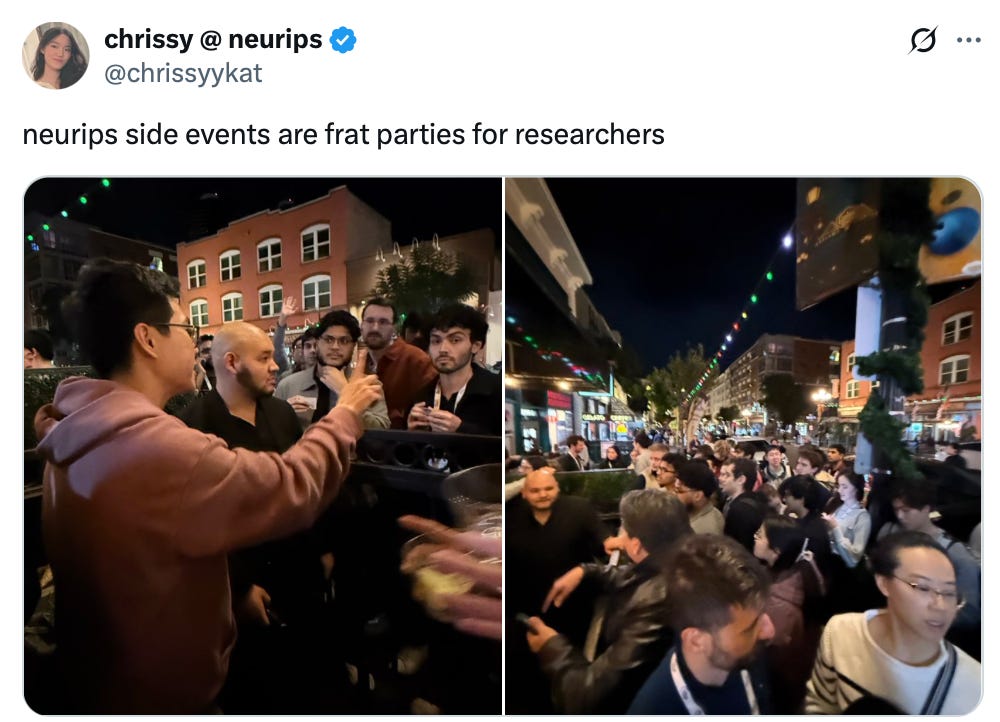
Having joined the list for Cartesia’s mixer, a few friends and I turned up to find a growing crowd hustled around the black gate cordoning off the bar’s smoking area. We had to jump back to avoid the gate’s trundling advance along the railing when the bouncer would mysteriously deign to let someone in.
We could feel the warmth of the bar’s outdoor heaters from our spot on the street, and we were able to look directly through the floor-to-ceiling windows of the place to see a whole room bathed in red light, near empty.
Then Albert Gu was summoned to the fore, getting on his tippy toes to better see the mass of hopefuls, finger emerging from the oversized sleeve of his dusty pink hoodie to point out his selects, who shuffled forwards eagerly.
Later, he reposted photos of the crowd outside the gate, captioned “neurips side events are frat parties for researchers”. Just as the “do you know a brother” of frat house yore, clearly the number of people who are rejected matters just as much or more than who makes it inside the club.
As reported extensively on Twitter, Lex Fridman was at every party, and at every party someone would excitedly whisper, “Lex Fridman is here!”. To which I would ask, “are you going to talk to him?” To which the response would be, “no, I’m shy” or “I don’t really know what to say.” I mean, what is there to say?
At some VC event, a friend asked me if I had met R, a lively-looking gesticulating young man by the bar. “He’s pretty big on Twitter.” When we met R, he introduced his mild-faced interlocuter as a guy he hadn’t seen in 11 years since their time together at Monte Vista High School in Cupertino. As they reminisced, another woman spawned out of nowhere and said, “I overheard you guys talking about Monte Vista and WE were talking about Monte Vista over there! Let’s merge conversations.”
As we clutched glasses of prosecco at a low-key startup happy hour, the CTO of a data labeling company explained to me why, in his view, Greenoaks is the #1 VC fund — “They have this insane strategy. Do you know Harker? The high school in the Bay? Yeah, so Greenoaks tracks Harker grads over five, ten years, through college and their early careers, then tries to recruit them. As investors, yeah. They’re in it for the long game. And they’re all technical guys, too.”
Some of this made me wonder whether Silicon Valley is becoming overly self-referential, too wrapped up in its own esoteric lore with the view that because we are doing the coolest thing in the world, the only people who matter are the ones in the know. At a global conference filled with the best talent from around the world, we have our own celebrity spotting, and our own social media buzz surrounding celebrity spotting. We have rooms filled with people from the same high school — not by coincidence, but by a self-fulfilling prophecy of who is worth paying attention to.
I also met one artist at the conference: the wonderful Leo Chan, who was exhibiting his participatory artwork An Evolving Portrait of Us which uses AI to blur together the faces of those who look at the piece. After a dinner, I observed the seventy faces of its attendees coalesced into a single portrait on his digital canvas. The face was soft, round, sort of central Asian, with full lips and the shadow of a stubbly beard and mustache, wearing faint boxy glasses frames — a bit like an androgynous, better-looking Garry Tan.
Leo looked at the portrait earnestly and said, “I see a lot of hope in this face.” I looked again at the wide eyes, youthful skin and slightly upturned mouth. I saw it too, the hope.
Among the very cool people I met this week were K, the founder of a startup that is attempting to predict and control the weather, with the ultimate goal of creating an AI scientist. I also met J, a researcher who is collaborating with a hospital to evaluate the efficacy of LLM-summarized patient notes in actual doctor workflows. C is training a knowledge graph neural network to learn all of the semantic links between sixty five million Wikipedia pages. D, the AI lead at a cryptocurrency, is using LLM agents to redteam blockchain smart contracts, increasing their robustness to adversarial attacks.
In my Uber to the San Diego airport to catch a flight back to San Francisco, I noticed that the driver kept switching back and forth between the map and another app. There was a gradient diamond in the corner: it was a long text conversation with Gemini. His last message to Gemini was simply an affirmative “Absolutely” — I watched Gemini type for a long time, three dots undulating, before coming back with a lengthy paragraph. Sensing my slight concern at the texting and driving, or perhaps wishing to keep an intimate conversation private from prying eyes, he swiped out of the chat, for then at least.
Needless to say, a real, incredible thing is happening. That is what brought a record 29,000 people to NeurIPS this year. At the same time, a pervasive sense of anxiety gave a sort of “enjoy it while it lasts” flavor to the festivities. I love conferences: I love the curiosity and overflowing questions with which crowds approach an interesting paper, the connections formed between niche research interests and the new friendships made. It’s great to feel like you can get into the grand, lushly funded party of superintelligence — even if inside, everyone’s hanging on for dear life, hoping the fun doesn’t end soon.
this is such a funny entertaining read. boots on the ground journalism!
https://open.substack.com/pub/evolvingtheory/p/the-ai-bubble-isnt-the-dot-com-bubble-b0d?utm_source=share&utm_medium=android&r=275w0u