you will never realize yourself!!!
by frequently asking for advice, we may be doing ourselves a disservice

I’ve recently noticed how much my friends and I reference the words of others when understanding ourselves. A single comment from a friend or even acquaintance about our people-pleasing tendencies, a proclivity for self-deprecation or more and less favorable career prospects can be taken as some truer truth than our self-knowledge.
This emerges partly from our fascination with being seen – even if we already know what someone is telling us about ourselves in some buried recess of the mind, it’s pleasurable to feel that you are seen and understood by others. The more salient aspect, especially among my female friends, is the idea that our true self is only knowable in relation to others.
I think about this like NeRF 3D reconstruction. Each friend beams a ray into your being, forming points of their contact with you on a 2D axis. By collecting enough of these points, via enough diverse angles of approach, we may be able to recover the 3D object that is our “true self”:
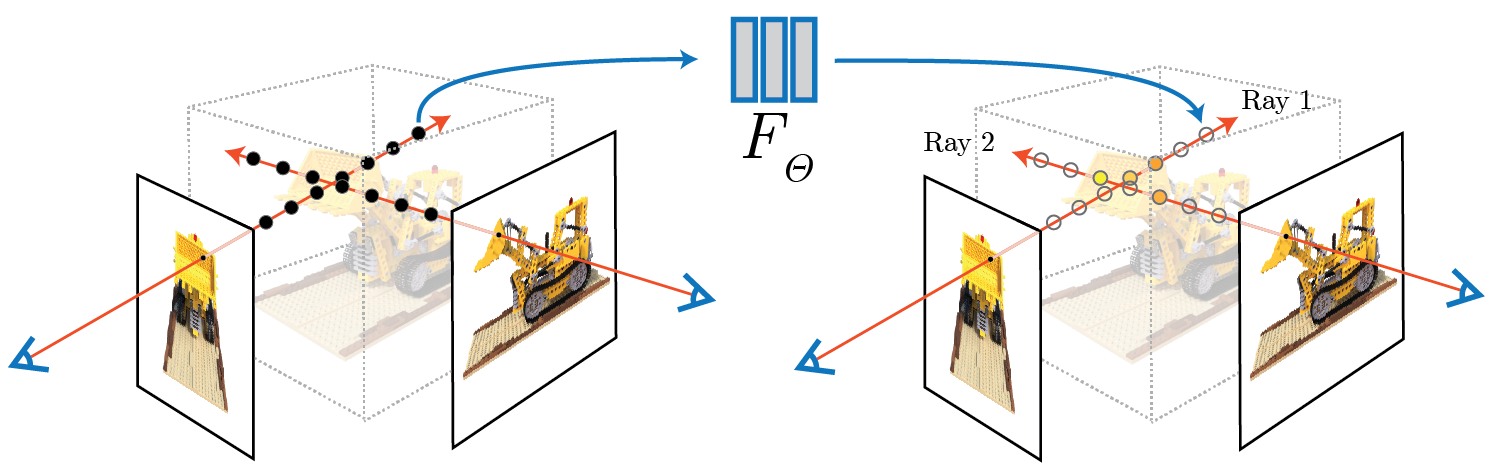
But the beauty and danger of seeing yourself through the eyes of others is that their language can come to structure your experience, shortcutting the process of your reaching your own language, and skewing what you ultimately notice about yourself. For example, NeRF can only reconstruct the object accurately with enough rays from enough diverse viewpoints. If the viewpoints are too similar — or the rays fail to pass through the object altogether! — we won’t get any meaningful signal at all.
Social media feeds exacerbate the compulsion towards expressing authenticity in order to be seen as authentic. The perception of authenticity is especially attractive in a performative environment (see: movement towards photo dumps, candids, absurdist captions and stories). But the stickiness of the algorithm traps us in mimetic loops that remove the possibility of authentic discovery. At the same time as you are discovering a niche trend, microcommunity or underground artist, so are thousands of others whose user profile matches yours.
Instagram encourages the display of authenticity via consumption: your clothing style, music taste, even the digestible expression of political stances through infographics — all of which are surely aspects of taste, but are quite uncorrelated from the “essential self.” Someone can both love Taylor Swift and be highly original and authentic. It’s beneficial for platforms to conflate consumption with personal development so that you spend more time and money in ways they can steer and profit from.
The expression of the authentic self does not exhibit through consumption but intuition; that is, the unique triggers built into your limbic system over accumulated experience. Which isn’t to say that in order to develop authenticity, we must have differentiated, niche experiences – rather, we must have first-hand experiences, which we can then process in our own ways.
If we constantly override our intuition by seeking the validation of others that that is in fact a correct intuition to have, we reduce our opportunities for experiences through which we can develop our own opinions and emotional responses. We spend our time triaging hypothetical scenarios rather than experiencing alternative realities.
There are, of course, reasonable limits to this – we consult friends to avoid worst case scenarios like abusive relationships, destitution, jail etc. But beyond that, I find that consulting others to make one’s own decisions is often an attempt at self-optimization to minimize the possibility of future regret.
One major arena in which this regret-minimization manifests is the choice of a partner. In Why Love Hurts, Eva Illouz argues that the abundance of choice in the dating market makes the choice of a partner more revealing of the private or inner self:
there are no longer formal mechanisms with which to pair people through their social status, because the criteria for mate selection become both diverse and refined, and mostly because they become integrated in the private dynamic of taste.
Then the choice of one’s romantic partner becomes the bridge between the interior self and exterior judgment: this is the person I choose above all others, so this is what I value above all else.
In order to put off a decision that would define us so deeply, we relegate prospective partners to the shadow realm of the situationship, where by not explicitly choosing somebody you do not feel obliged to subsume them as part of yourself, by both your private and public reckoning.

I recently watched The Drama, which explores the question of what it really means to commit to someone unconditionally [spoilers ahead]. When Emma (Zendaya) reveals of the worst thing she’s ever done, her fiance Charlie (Robert Pattinson) laughs along. It is only when their friend Rachel reacts cataclysmically that Charlie begins to fall apart. He goes and asks his friends what to do about the engagement. They are more horrified than him, more resolute than him, telling him that she’s a psychopath, that they would call the police on her.
Charlie’s friends don’t know Emma like he does, so it’s easy for them to weigh in with moral imperatives. He tries desperately to persuade them, in an attempt to persuade himself, of both the personal and social circumstances that would lead her to her past action. But he can’t take it, both the heaviness of her admission and the contrary advice of those around him. Ultimately, he is the one who destroys their trust and the wedding – not Rachel, whose sardonic speech is harsh but not disastrous – by sharing Emma’s story with someone untrustworthy, and cheating on her.
Up until and perhaps even after his infidelity, Charlie abnegated responsibility by allowing himself to be carried along by how others felt about Emma’s admission. Listening to others gives us an easy way out. You never have to be fully responsible for your own misery, should it come – you can curse the bad advice you were given, while secretly enjoying the moral safety of believing that you would not have chosen to do so had you had true freedom to make your own decisions. But do you not have freedom? You exercised that freedom by choosing who to listen to.
It is much more terrifying to go it alone, against advice, as you will then be responsible for what seems to be unbounded downside. But we cull the possibility of ever developing a strong character if we constantly outsource our decision-making to others.
It’s easy to treat authenticity as an anticipatory intellectual exercise rather than an evolving state of being. As a young person, there is no fixed self to be faithfully authentic to — it is that self that we are actively creating. It’s a pleasure and privilege to have friends who will engage with us on the subject of our self. But we should also recognize that every time we do so, we are demoting the importance of our inner voice in making decisions. Over time, it may cease to speak at all.
all ideas in this essay are still in development. please leave your thoughts in the comments!!
i love eva illouz, also i fear ai will make (has already started to make) the last ~50% of this post so much worse
pretty incisive, was just reflecting on how external perception drove a lot of my choices… a corollary:
the social media algorithm is an EMA of our taste and is projecting an old image of us that we’re constantly outgrowing. (the algorithm is sticky: i heard there’s a spotify study where people will just listen to what the algorithm suggests and don’t click into new artists even if they like them) so it’s probably also useful to forget this sticky representation of you and reinvent yourself from time to time